


Certificate and private key management
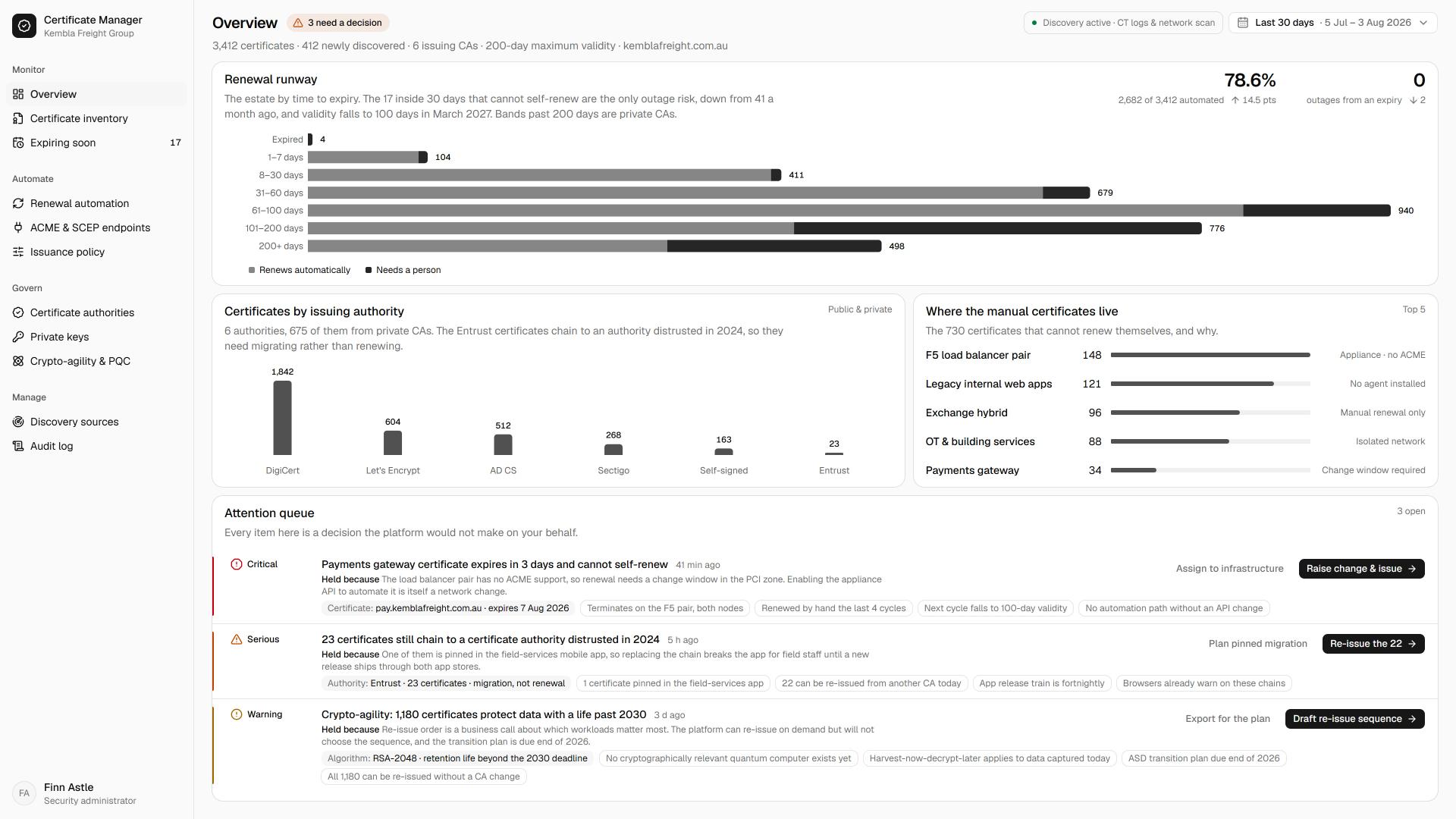
The 47-day clock has already started.Certificate validity is falling from about a year to 47 days, and you can't renew what you can't see. We match you to a platform that finds every certificate from any authority and renews it before it expires.
Get startedSee how we benchmarkNo fit, no obligation.
Renewal stopped being a once-a-year job.
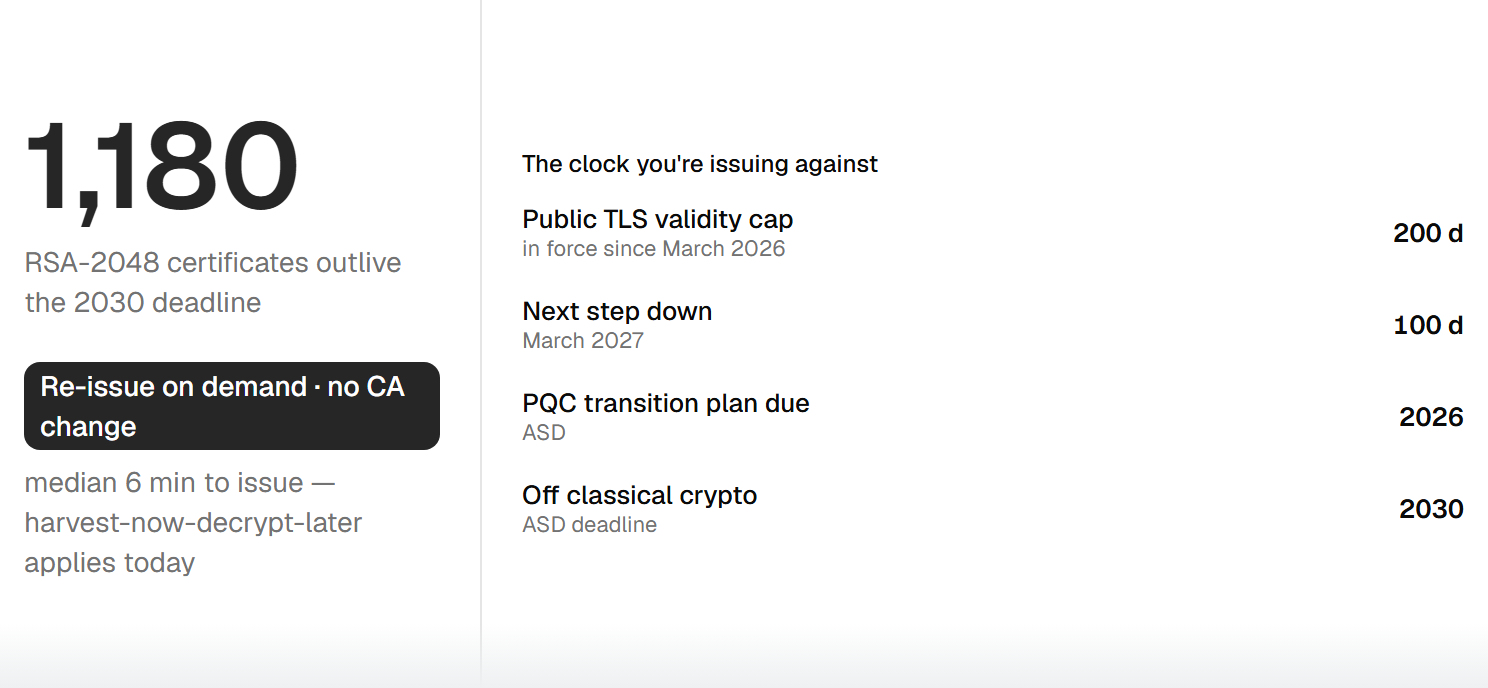
The CA/Browser Forum has locked in a schedule that cuts the maximum life of a public TLS certificate from around 398 days to 200, then to 100, and finally to 47 days by 2029. Domain-validation reuse drops to 10 days over the same period. A task your team did once a year is becoming something closer to once a month, for every certificate you own.
A second deadline sits behind it. The Australian Signals Directorate wants organisations off today’s public-key cryptography by the end of 2030, with a transition plan due by the end of 2026. Neither date is a forecast or an opinion. They are published schedules, and they set the work whether or not a certificate has ever caused you a problem.
Four problems the schedule creates.
Certificate management used to be a calendar reminder. Now it is four distinct problems at once.
Seeing what you have
Most teams track certificates in a spreadsheet and their memory. By industry surveys, only about a third of organisations have a complete, current view of every certificate they own. You cannot renew the ones you cannot see.
Renewing before they expire
At 47 days, manual renewal does not scale. One missed certificate takes down a website, an API, or an internal service, and the outage arrives without warning.
Every authority, not one
Certificates come from several public and private authorities, each with its own console. When one authority loses trust, as Entrust did in 2024, every certificate from it needs replacing at once.
The clock on quantum
Data captured today can be decrypted once a capable quantum computer exists. Long-lived data is a present-tense risk, and the ASD deadline to move off today’s cryptography is fixed.
You can't automate what you can't see.
Automated renewal is the feature everyone demonstrates, and it only works on the certificates you already know about. The outages come from the ones you don't: a certificate a team stood up two years ago, on an appliance nobody owns now, quietly counting down to an expiry that will surprise everyone.
So the first job is discovery, not renewal. A complete, live inventory of every certificate across your estate, public and private, is what everything else depends on. Get that wrong and automation renews a fraction of the problem. Get it right and governance, renewal, and the quantum transition all have something real to work from.
What good certificate management gives you.
What good looks like once the schedule is against you.
A live inventory you can trust
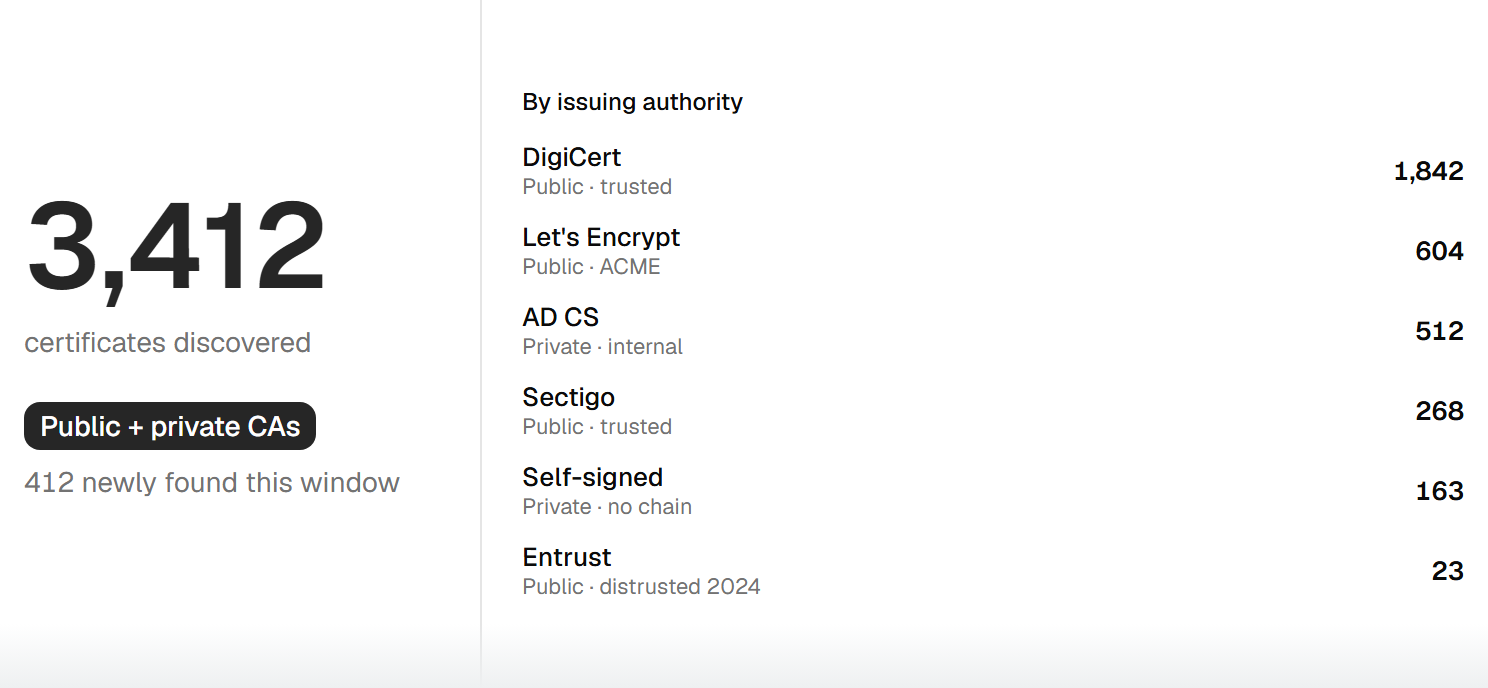
Continuous discovery of every certificate from any authority, public and private, so nothing is counting down where you can't see it.
Renewal that keeps pace with 47 days
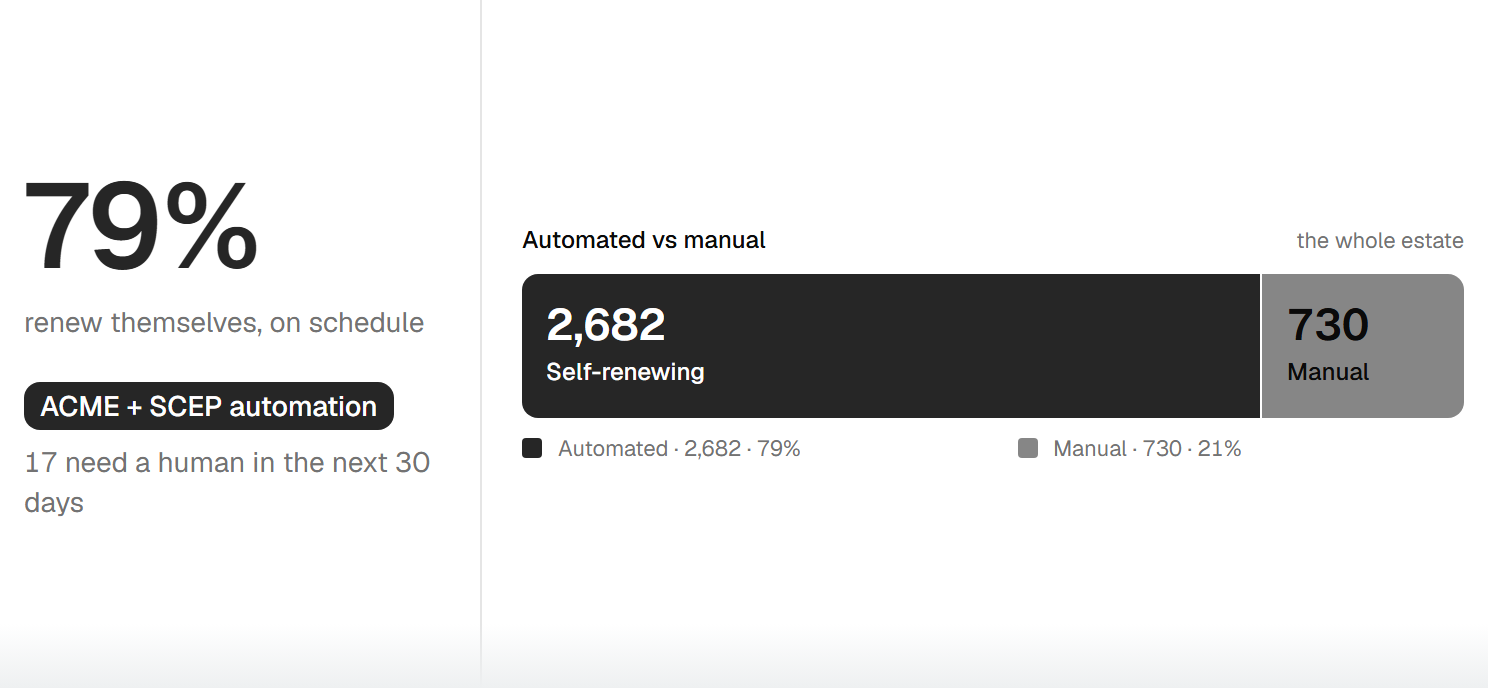
Enrolment and renewal automated through open standards, so certificates replace themselves on schedule and an expiry never becomes an outage.
Ready to change algorithms on demand
Crypto-agility, the ability to find and re-issue certificates as standards change, so the move to post-quantum cryptography is a managed process, not a scramble in 2030.
What can the top platforms do?
Buying certificates from one authority is procurement. Managing every certificate across its whole life, from any authority, is the job now. These are the capabilities that separate a platform that governs your estate from a console that only sells you certificates.
Continuous discovery across the estate
Finding certificates on your network, in the cloud, and on appliances, not just the ones already in a list. Worth knowing: a "scan the internet for your certificates" feature is usually just Certificate Transparency log monitoring, which is public and free, so treat it as table stakes, not a differentiator.
Authority-agnostic lifecycle
Managing certificates from every public and private authority in one place, so a trust event at one authority becomes a bulk re-issue rather than an emergency.
Automated enrolment and renewal
Open standards like ACME and SCEP doing the renewal work, so a 47-day cycle runs without a person in the loop.
Policy and governance
Central rules for who can issue what, and from where, so certificate sprawl does not quietly rebuild itself.
Expiry monitoring and alerting
A warning well before a certificate lapses, tied to a named owner, so the renewal has somewhere to land.
A private certificate authority as a service
Issuing internal and machine certificates without standing up and maintaining your own PKI, described as what it is: a delivery model, not magic.
A crypto-agility inventory
Knowing which algorithms sit where across your estate, so the transition off today's cryptography before 2030 is planned from evidence.
Where most teams sit today.
Certificate management maturity, tier by tier.
Focused
Certificates tracked in a spreadsheet, renewed by hand, discovered when one expires and something breaks. It worked when certificates lasted a year. At 47 days it will not. Many mid-market teams sit here.
Broad
A complete, live inventory, renewal automated from any authority through open standards, and expiry tied to a named owner. This is where most teams need to get to before the validity cuts bite.
Comprehensive
Governance and policy enforced centrally, a private authority delivered as a service, and a crypto-agility inventory ready for the post-quantum move. Where the ASD timeline and the regulators are heading.
Questions we hear most.
Start with your goals.
Tell us what you need to protect.
We'll match you to the tools that fit.
No fit, no obligation.