


Security awareness training
Training that changes behaviour.Your people are the control that activates once a threat gets past your technology. Finishing a module proves attendance, not competence. We match you to a program that changes what people actually do under pressure, and measures it.
Get startedRead the security awareness assessmentNo fit, no obligation.
Most programs fail before the platform is chosen.
Most awareness training in Australia is not failing because the right platform does not exist. It is failing before the platform is ever chosen. The tool gets picked by IT on compliance criteria rather than efficacy, rolled out once, and left unsocialised. Around two in three platforms on the market can genuinely change behaviour. Only around one in thirteen programs actually do. That gap is about how the program is built and run, not about the software.
So the decision in front of you is not which content library to buy. It is whether you are building a behaviour-change program at all. A platform is a tool. A program is a sustained effort to change what people do, owned by someone, measured over time, and treated as organisational-change work for the first six months rather than a piece of technology to switch on.
Three ways to teach, only one that sticks.
How a platform teaches matters more than how much content it holds.
The library
A huge catalogue you are left to curate. Most of it is never watched. Volume looks impressive on a feature sheet, and turns into a queue nobody gets through.
The exam
Quiz first, train only the gaps. Efficient on paper, but it assumes people already have the foundations, so it tends to patch holes in a wall that was never built.
The curriculum
A sequenced pathway that builds the foundations in order, like a school. Someone with the basics can handle most of what attackers throw at them, even a lure they have never seen. This is the approach we recommend for most Australian teams.
Completion is not competence.
A completion rate tells you people attended. It tells you nothing about whether they will behave differently the day a convincing lure lands. The two come apart more than most boards realise. In Proofpoint's Australian data, 96% of people who took a risky action knew the action was risky and did it anyway. Knowing is not the same as doing, and awareness on its own does not close that gap.
The measure that matters is behaviour under pressure, tracked over time and expressed as a single defensible number a board can act on. Not a dashboard of module counts. One score that moves as real behaviour changes, so you can show whether your people are a smaller risk in twelve months than they are today, and act on it if they are not.
What a real program gives you.
What a program earns you that a completion rate never will.
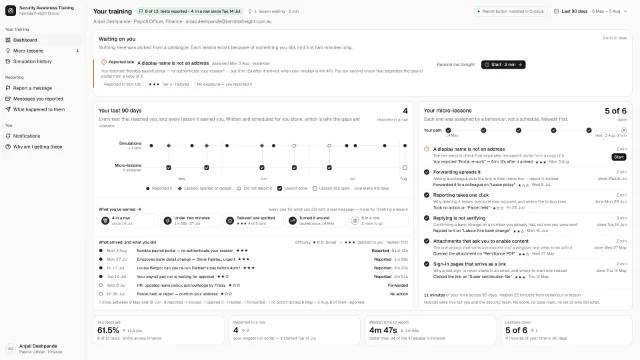
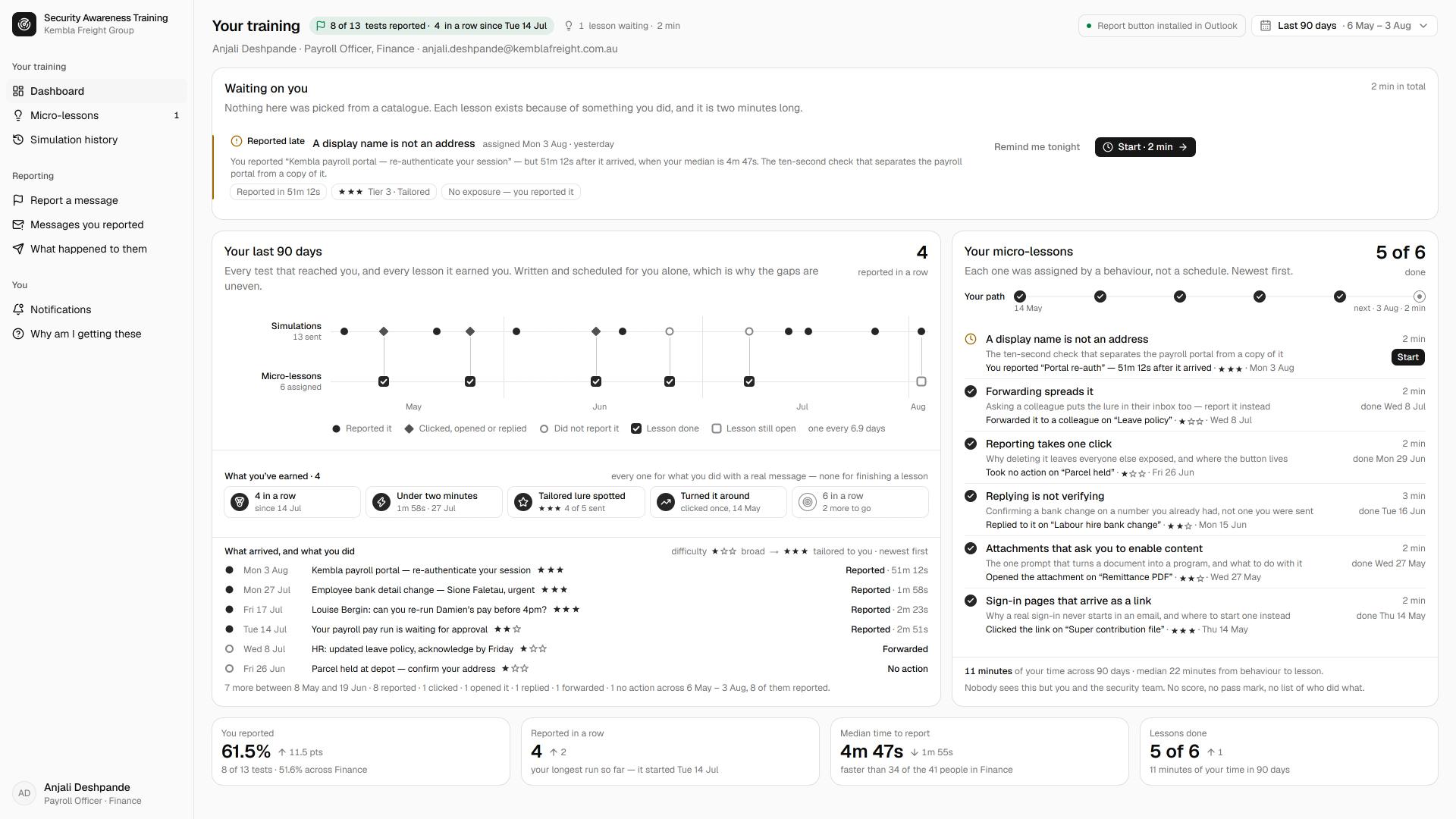
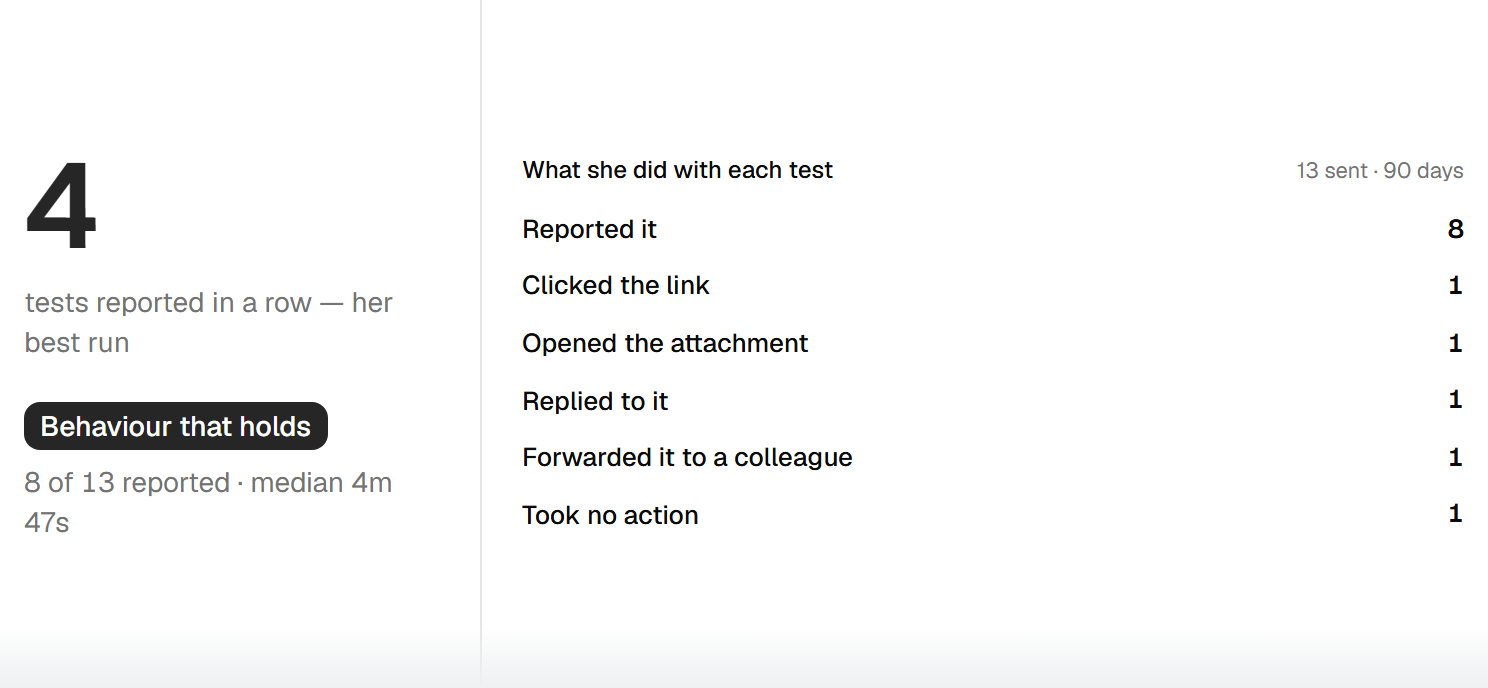
Behaviour that holds under pressure
People who report a real lure and pause on the unusual request, because the foundations were built in order, not because they happened to have seen that exact scam before.
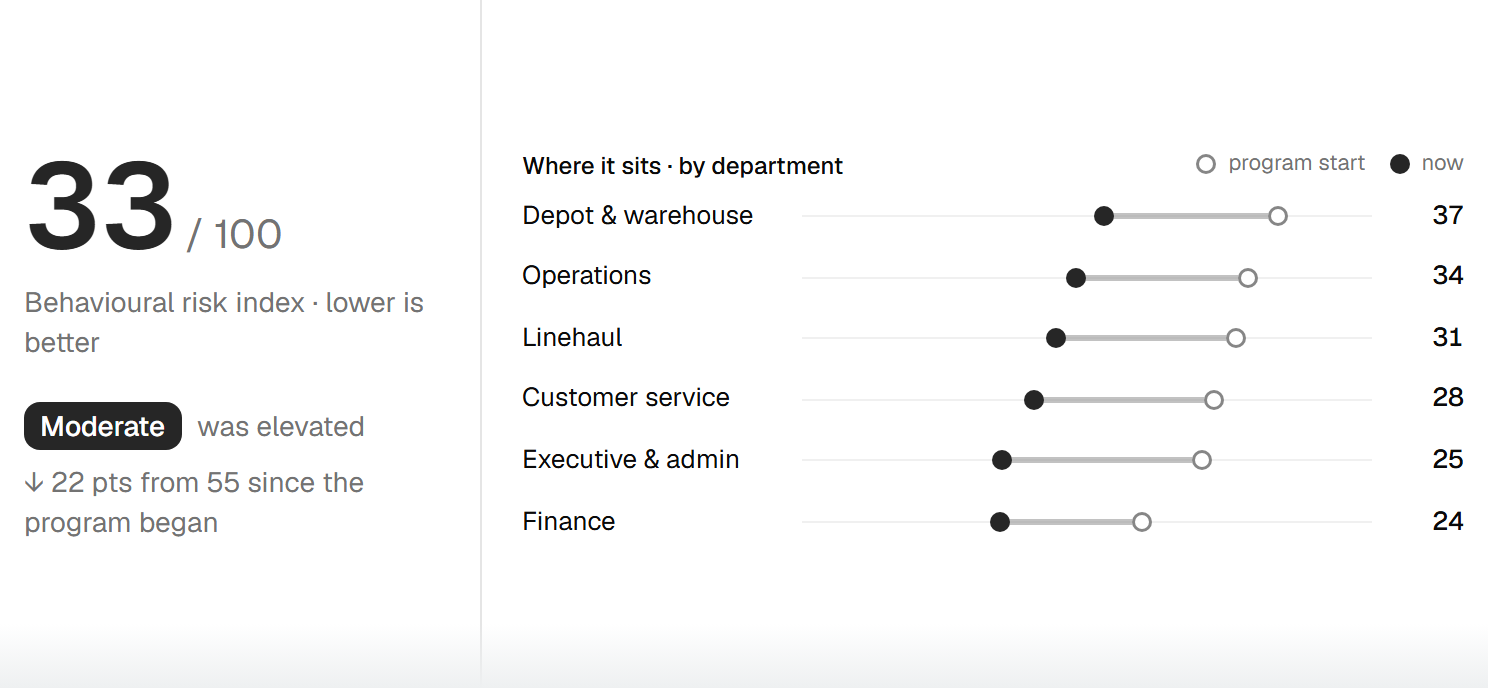
One number the board can act on
A single behavioural risk score that moves as behaviour changes, so you can evidence progress to leadership, an auditor or an insurer, and see where the risk still sits.
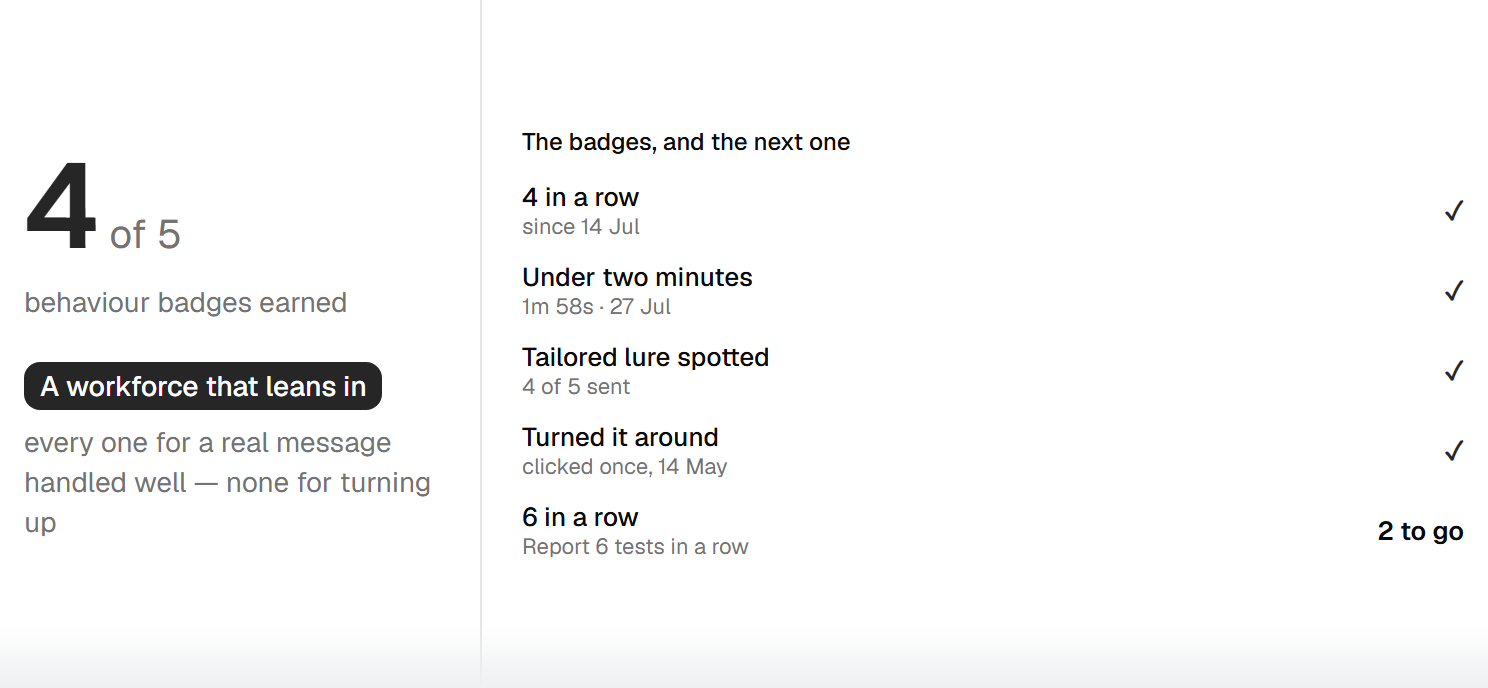
A workforce that leans in
People who treat the program as protection, not a trap. Reporting goes up, shame goes down, and engagement holds, which is the difference between a program that lasts and one that quietly dies.
What can the top platforms do?
A content library, scheduled phishing simulations and completion reporting are the baseline every platform clears. These are the capabilities that separate a program that changes behaviour from one that only records attendance, and where genuine AI in this category earns the word rather than dressing up rule-based scheduling.
Adaptive, per-user simulations
Difficulty and lure that calibrate to each person's real risk profile, not the same template randomised across the whole company.
A sequenced curriculum
Foundations built in order for each learner, so training compounds rather than scattering across a catalogue nobody finishes.
One-click active reporting
A report button in the inbox that turns every user into a live sensor, so a real lure is flagged in seconds rather than clicked.
A single behavioural risk score
The one number that translates behaviour across simulations, reporting and training into something a board can act on and track over time.
Timely threat alerts
Short, current briefings on the scams actually circulating in Australia right now, so training reflects this week's threat, not last year's.
Genuine per-user AI
Content and difficulty selected dynamically from a real risk profile, which is what AI means here, not template randomisation or a rules-based schedule wearing the label.
Where most programs sit today.
Security awareness maturity, tier by tier.
Focused
An annual training module and the occasional phishing test, reported by completion rate, run to satisfy an audit. It ticks a box and rarely changes behaviour. Many mid-market teams sit here.
Broad
A sequenced curriculum, adaptive simulations and active reporting, run as an owned program with a behavioural risk score tracked over time. This is where most teams need to get to, and where behaviour actually starts to move.
Comprehensive
Per-user AI calibration, behaviour measured continuously and fed back into the business, and a security culture that shows up in how people act without being prompted. Demanding to sustain, and the level auditors and insurers increasingly expect.
From the Lab
We tested the training platforms.
We benchmarked the leading human-risk platforms against the same tests, including which ones genuinely calibrate to the user and which only look like they do. So the ranking reflects what we measured, not what a vendor claimed.
Read the assessmentClient story
From 22% clicking to 4%, across 19,000 staff
Our people now report suspicious email instead of clicking it. Across 19,000 staff, that shift is exactly what we were after.

Questions we hear most.
Start with your goals.
Tell us what you need to protect.
We'll match you to the tools that fit.
No fit, no obligation.